Showing posts with label In-Country Blogs. Show all posts

Sunday, March 11, 2018

Day 9: My Personal Takeaways (Lex)


The past nine days in Belize have been some of the best of my life. It was educational, enlightening, and most importantly enjoyable. Being able to go beyond the classroom and learn through experience is beyond compare. I love to travel and I feel it is the best way to learn about the world around us. This trip has done nothing but reaffirm that.

I feel my biggest takeaways from this trip, other than the 1,000 bug-bites, would be my ability to interact with the locals. There are three specific moments that I look back on when thinking about how I grew. The first would be our visit to Mopan Tech. We had gone over our presentation the day before and I was really nervous. I hate public speaking and giving presentations. We started our day at the school with a tour before we gave our presentation. The Penn State students were thoughtful and asked questions throughout the tour, but when we were left alone to interact with the students I think we were a little shy or slow to reach out. Not speaking for everybody of course, but I felt this was especially prevalent for me. I didn't know if these kids were going to want to talk to me. It felt awkward for me to walk into their classroom and disturb them from doing their work. When we shifted gears to our presentation nothing felt different. I still didn't think these high schoolers were going to take me seriously seeing that I was the same age they were. I think our group was trying to engage with them but there were some awkward moments when it wasn't working. However, there were some very bright students there that made our jobs easier and participated enthusiastically. I enjoyed visiting Mopan Tech and seeing the things they were doing, but to be honest I was glad that the presentation was over. 

The next experience I look back on was our trip to the San Ignacio Market Wednesday morning. I will try to keep this part brief since this is what I wrote about in my previous blog post, but it is still an important piece in my personal development on this trip. We started in the market as one big group of 8 Penn State students. We all went to the same stand awkwardly asked some of the prices of the foods being sold. Then we split up more into our three groups and Britton, Erin, and I met Daniella. I began to ask her questions on the produce she was selling just like the first vendor. Then I asked her about the local Mayan cuisine. She seemed to light up and began to realize we weren't just tourists but curious students who wanted to learn. She was so happy to share a part of her culture with us. I began to feel much more comfortable and it became a more flowing conversation instead of me just asking about prices. This is the point in the trip I look back on to when I began to switch how I interacted with the locals. Instead of being shy and observing from a distance I wanted to show them that I was curious about their lives. After that, they were more than happy to talk to me.

The third experience I look back to for my development, and also the development of the group, would be the second presentation at the Tumul K'In Center for Learning. I feel that our presentation at the second school was much much better. We were more confident in ourselves and our ability to interact with the students. I felt that I took control with my group to try to get them to participate and enjoy the activity. Once again there were several bright students that made my job easier, but I still feel that overall we did a better job the second time around. In the short moments when our group would be waiting for the others to finish we were able to talk with them and ask questions about their lives and their school. They were so genuinely interested in what we had to say and were able to recognize our curiosity which made them want to share more. Even after the presentation was over, all the Penn State students stayed behind and talked with the students some more. 

With Tumul K'In being a much smaller school (24 students) compared to Mopan Tech (over 500) it was a lot easier to engage with their students on a more personal level. I also really enjoyed our second presentation with the students at Tumul K'In, whereas I was glad to get it over with at Mopan Tech. I was so happy to have a second chance to interact with the Belizean students and learn more about their ambitions. The question "What do you want to do with your life" always scares me and I never know how to respond. Whereas these kids knew exactly what they wanted to do and were eager to share it with us. I am so grateful for this opportunity to come to Belize and interact with such incredible people. Places can be great, but it the people there that make it special. And it's our job as international students to be able to take that extra step to reach out and engage with the people. After all, the best way to learn is by experiencing it first hand. 


Lex is a freshman majoring in BioRenewable Systems/Biological Engineering at Penn State.

Saturday, March 10, 2018

Day 8: Orange You Glad I Didn't Say Banana (Kryslynne)

Today we got the chance to tour a local banana farm. Being involved in the fruit farming industry myself I noticed a lot of similarities and differences between the two farms. Also, I had somewhat of an idea what we were walking into when we went into the field. Even though I'm not as knowledgeable on the fruit growing in tropical climates I was still super excited to learn more about how they do things here in Belize.

On the banana farm, the growers prune or trim the trees after they remove the bunch of bananas. Even though we don't prune our trees after every picking we do make sure they are at least trimmed back once a year. This helps the plant regenerate growth by cutting off the "suckers". Suckers can be branches, leaves, or roots that just suck up all the water and nutrients taking away from the plant itself. If you don't cut off the suckers the plant will suffer. 

One difference I noticed between the two farms is how they distribute pesticides. The farm uses a plane that fly's over the fields distributing the pesticides. Back home at our farm, we use a pull behind sprayer that is attached to a tractor. Both methods have their own benefits but I don't think our farm would be able to use planes as a way to spray no matter how cool that would be. 

After touring the banana farm I personally think it would be easier to grow one fruit than numerous ones like I do. We grow so many different types and varieties of fruits that we have to know a lot more about each individual tree. For example, I don't just need to know how to thin an apple tree I have to also know how to thin a peach or nectarine tree as well. Plus there are numerous varieties of peaches or apples that must be cared for differently. So the fact that they can focus on one type of fruit sounds more appealing to me( lol get it bananas, appealing? no okay). Don't get me wrong, I love fruit farming and I love my farm, but I do think the way they do things is less challenging.

Kryslynne Vroman is a sophomore majoring in Agricultural Education and Extension at Penn State University Park 


Day 8: Banana Trees? No Way! (Olivia)


On our final day in the beautiful country of Belize, we concluded with an exciting tour of Bunches of Fun banana farm, which was something that I was particularly interested in considering my academic emphasis on plant sciences. I went into the tour unsure of how I would be able to connect tropical fruit agriculture with American farming practices; however, I quickly realized that there were far more similarities than differences.

First, our tour guide Evin was an Oklahoma native who did her undergraduate in Agricultural Communications from Oklahoma State University. Clad in her Twisted X moccasins and bright blonde hair, I couldn't help but see a little bit of myself in her. The Belizean transplant found her way to the Caribbean country through an internship, similar to my recent international internship experience in Norway this past summer. 

Throughout the tour, Evin taught us about the morphology of banana plants, common production practices, and environmental stewardship efforts. The first thing that I learned is that bananas are a member of the grass family, so technically there is no such thing as a banana tree because it lacks a woody stem. This is similar to American grains, such as corn and wheat, which are also members of the grass family. 

She also taught us that field waste is composted for six months and then reapplied to banana plants in the field so that nutrients that are taken from the plant can be reintroduced to the soil. I know that all of the students on the trip are interested in environmental conservation and stewardship so this particular aspect of the tour really resonated with my fellow students and me. 

Belize has been an incredible opportunity for me to expand upon my appreciation of global agricultural systems. Agriculture has played a vital role in the development of each and every society, but this trip has taught me that agriculture doesn't necessarily have to look "American" in order for it to be productive. Previously, I never would have considered bananas as a critical part of the global agricultural systems. However, I have now realized that agriculture takes many shapes and sizes. Many thanks to my new friend Evin for teaching me that valuable lesson. Go Pokes!

Olivia is a sophomore majoring in Agricultural Sciences at Penn State 

Day 7: New Day in Tumul K'in (Britton)

As I arrived at the Tumul K'in Center of Learning I made the connection that during this trip we would be attending a traditional Mayan High School, and this was it. I think it was the second sentence that Mr. Pop said that Tomulkin meant a new day in the native Mayan Language. 

This is when it hit me like a bus, that it was not only a new day for myself but a new experience, unlike anything I have ever experienced before. When I first arrived at the school I realized that there were only four students in the first year (9th grade) and they were all girls! I was talking to two of the four girls in the first year and they were telling me that they have the job of caring for the garden. The school has its own garden, this was something that didn't totally surprise me, but the next part did. That was when Mr. Pop made the statement that the school grows its own produce to use in the kitchen of the school. The produce supplies the students with 3 meals for 10 days. The students live on the school grounds and are there for 10 days followed by going home with to their families for four days. This was the first part of my new day and brand new experience.

While touring the learning center I came across so many new experiences and new ideas that I would have never thought would be found in this Mayan school. The fourth-year students all have their own projects, this is relatable to back home having a senior project in high school. The students were really passionate about their projects due to being able to choose the type of agriculture that they are most passionate about. While on the tour I tried something new, something I knew wouldn't end well, but it was a living on the edge moment. I ate a HABANERO pepper, it made my face feel like it was on fire, and fire should have been coming out of my mouth.

Sure I should have known not to eat the habanero, BUT I knew that if I didn't try it then I never would. I never wanted to think back to my NEW DAY and wonder what the Habanero pepper tasted like. After the Habanero experience, I got to continue my new day with new experiences and actually got to take part in a dance class that the fourth year students presented to us. I never felt more reliant on another person before, without my partner Anthony I was lost. I feel like without this experience I would be lost. This was a new day for myself and I know that taking the jump into the new experience it will bring me more new adventures and NEW DAYS for my future students in my future classroom.


Britton is a sophomore majoring in Agriculture Extension Education major at Penn State.

Day 7: Living a Legacy (Erin)

"Legacy; What is a legacy? It's planting seeds in a garden you never get to see." 


-Lin Manuel Miranda

In the way that I am obsessed with the musical Hamilton, Alexander Hamilton was obsessed with his legacy, and what he will leave behind. Day seven was filled with the concept of leaving behind a legacy for others. A moment in time seeing the work put forth towards the future.

In the morning we went to Tumul K'in Center of Learning. Tumul K'in translates to "A New Day" and it's foundation was built on teaching students Mayan values. The Mayan community saw a generational gap between the young, and old. They decided that they didn't want to leave behind their Mayan heritage and their legacy. In turn, the learning center was built. Students came to the center for high school, and along with regular classes, students learned the local Mayan languages and traditions. It was an amazing experience to see students so young living out the legacy their ancestors left before them.

Later in the day, we had a discussion with Mayan farmers. The question of "What do you see for the future of your farm?" was posed. The farmers explained that farming had been a part of their culture for generations. They had hoped that their children might some day take over. I saw a connection to farming in the United States. There's an increasing disconnect between the farmer and the consumer. People everyday are leaving the farm to explore other opportunities. It's a reminder that all of us, Alexander Hamilton, Mayan farmers, my classmates, myself, and everyone out there, has no idea what their legacy will be. We just need to keep working towards leaving behind something positive.

Erin Langdale is a sophomore studying Agricultural and Extension Education at The Pennsylvania State University.

Day 6: Dwayne's a cool dude (Kurtis)

A good bit of this post won't be about anything from the itinerary, which I think is a beautiful aspect of travelling. You see, this morning before breakfast, Lex and I were waiting for the girls to come down so we could all walk to breakfast together. The owner of the hotel we were staying at, Dwayne, invited us into his office for some coffee. I started a conversation with him about something intriguing about his office - how he has a picture of the Obama family and a picture of Trump hanging in his office. I asked him about it and we started a conversation about politics (the day before was Belize's election day). He shared that he thinks Trump was a good idea for America; he thinks we needed a change because we continue having "establishment politicians" as he shared. I found this intriguing and controversial as, in my opinion, Trump is very American-focused and could threaten developing countries by not providing as much support.

Another very interesting piece of information Dwayne shared was about agricultural development in Belize. Dwayne used to be a rice farmer, farming approximately 200 acres. He shared with us that, while the US does not provide subsidies or support to Belize for its agriculture, European countries directly subsidize farmers in Belize. He did tell me a concern, however, which was that those subsidies will be ending soon. Belize has tried to support its farmers for when this day comes by improving infrastructure in Belize's "Banana Belt", by building more and better roads, and increasing access to electricity in the area.

After breakfast, we drove to our accommodations in Toledo district - a cabin maintained by a Mayan village. It was a challenging experience for me and most of the other students because we had had wifi at all of the other lodging places, and now we would be without any technology for 2-3 days. As soon as we had unloaded our bags, we went straight to our farm tour for the day with Manuel. Manuel is a Mayan farmer who has learned all of his practices through experience and knowledge passed down by his family. He produces cacao, nutmeg, corn, beans, squash, sugar cane, pineapples, and many edible palms. Something I found intriguing is how little the corn and beans he grows have changed in the past 100 years or so. This is a stark contrast to American varieties of these crops, which have changed so much in just the past 20 years. Manuel held differing opinions about education and agriculture than me, which challenged me. He strongly supports education, but still wants Mayan children to come back to the farm after they have finished their higher education. This seems counter intuitive, as education is frequently used as a tool to lift people out of subsistence farming.

The last thing I'd like to share about is our tour of the Marie Sharp's hot sauce factory. By this time on the trip, I had already fallen in love with their hot sauce and was putting it on every meal available. It was a fairly typical facilities tour, but two important take-aways I had were how Marie Sharp refuses to overly-automate her factory because it would put people out of their jobs, and she wants to provide jobs for as many people as possible. The second nugget of information is a comparison. During my internship last summer, the company required employees doing strenuous jobs with their hands to perform light physical therapy at least once a shift. Marie Sharp's requires the same of their employees when they are doing repetitive and stressful hand motions. I saw this as a great comparison between working environments in America and Belize, and as a way to break stereotypes. Before this trip, knowing Belize was considered a developing country, I had an expectation that working environments would be different than in the US. I'm very glad I had my ignorance of Belize challenged, and had this opportunity to learn from its people.

Kurt is a senior in Animal Science major at Penn State.

Day 6: Manuel's Farm (Gillian)

Visiting Manuel's farm in Laguna on Thursday showed the values found within the Mayan community and served as a good reminder of values that I find important and hope to strive for in my life as well. Hard work, community, peace, and protection of the natural resources are just some key values that I was lucky enough to see in practice.

There's no doubt that Manuel works hard. His beautiful farm is covered with plants and crops that he cares for, manages, and harvests. Situated with terrain and heat and a number of different obstacles such as narrow paths, Manuel spends a lot of time working with his extensive knowledge to keep the farm running. Meanwhile, he also works to prepare for the future by planting for his children to take over once they come back to the farm after education.

A strong sense of community was also found throughout the day. Manuel and the family I had lunch with discussed the importance of helping one another. A perfect example is replacing the thatched roof every few years. If a few men come together, they can complete the whole process in half a day! It definitely shows that we're stronger as a team, something I've seen within our group this week as well. We have all become close and help each other out to make sure we're prepared for the experience... and have enough sunscreen!

Although it might not have been obvious, there was a sense of peace at the farm. I've heard many times that being outside is good for the mind and body, and Manuel's description of his connection to the land truly shows that belief. He feels that by eating what he produces and drinking the water from the creek he has remained healthy. Connecting to the natural world that way is incredibly powerful and cleansing. I know I've felt my worries drift away when I'm outside!

Finally, protecting that connection with nature requires the protection of natural resources. Hearing that conservation is a value within the community is really inspiring as it's something I care about deeply as well.

This farm visit was very special to me as it gave me the opportunity to learn about and see values of the Mayan community in practice. I was pleasantly surprised to learn that I value similar things. Finding common ground and similarities despite some differences helps us to understand, appreciate, and further connections. I'm excited to apply this new information in future interactions!

Gillian Warner is a freshman majoring in an interdisciplinary major
in the College of Agricultural Sciences at Penn State.

Wednesday, March 7, 2018

Day 5: Marie Sharp's (Sarah)


Throughout the trip in Belize so far, my classmates and I have been interacting with many different forms of education. Today we were able to engage in informal and non-formal education through different outlets, including a non-formal tour at Marie Sharp's hot sauce factory.

The tour leader, Danny, had asked the group if we were students and where we were from. At hearing our reply, he told about how he had never been out of his country of Belize and has never seen snow. Danny said that he might eventually travel out of Belize, but he probably wouldn't go to somewhere with snow. He then continued to tell us, later in the tour, how he was thinking of going back to school since he has only his associates degree. A degree that he was able to receive while at school in Belize, but furthering his education would mean that he would have to travel to another country.

This non-formal interaction also included explanations of the hot sauce process, along with a background of the company. Danny told how the women that work in the hot sauce factory are still employed because Marie refused to upgrade to machines that would have replaced the workers. Marie had a purposed plan for the machine but put the plans to the side when her workers would have nowhere else in the factory to work. To this day (mainly female) workers process the fresh produce in the factory and cut the vegetables by hand for hours during their workday.

Marie Sharp's company prides themselves on being not only a productive company that brings in a large revenue but also a company that provides a livelihood for their factory workers and their farmers.


Sarah Miller is a Penn State Senior majoring in Agricultural Sciences.

Day 5: San Ignacio Market (Lex)

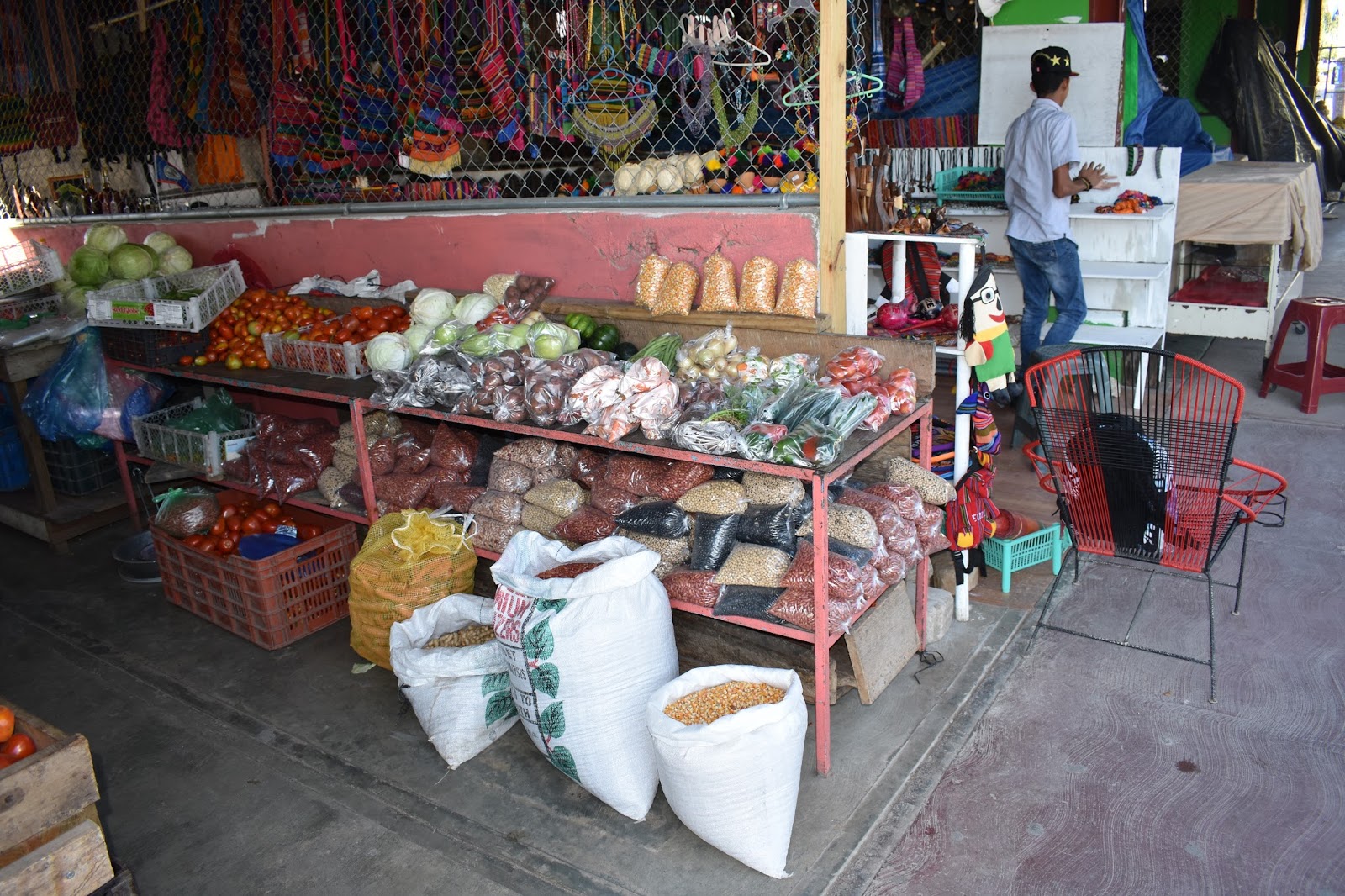
Today marks the midway point of our AEE 499: Indigenious Knowledge in Agriculture and Extension Education trip to Belize. We started off the day with a challenge task from our C.E.L.A. Belize guide Lauren to exploring the San Ignacio Market. The eight students split into three groups.

Group 3, made up of Britton, Erin, and myself, set out to create a nutritiously balanced meal from the ingredients in the market. We were given a $10 Belizean Dollar budget (the conversion rate to US dollars is 2 to 1). Our group originally planned to create a hypothetical meal and determine the prices for the ingredients. For example, I wanted to know the price difference for beans versus eggs in order to decide what our protein would be. Of course, these prices depend on the variety of beans and the eggs.

After trying to plan an American inspired meal without much success, I decided to ask one of the vendors what might be a local Mayan dish that would meet our nutritional needs. A conversation began between the vendor (Daniella), the students (Britton, Erin, and myself), and a lovely customer willing to share. She explained to us the recipe for Caldo which is a local soup that includes chicken, onions, cilantro, lime, jalapeños, and corn flour for homemade tortillas. With every ingredient listed, there was more and more knowledge that came with it.

In Belize, they have “Local” chicken and “Normal” chicken. Local chicken are raised traditionally, allowed to roam free. Whereas normal chicken are raised by Mennonites with more modern techniques like in the United States. The quality between these two are very distinct. The price for local chicken eggs in the market is $12 per tray, whereas normal eggs are $7 per tray (all Belizean currency). Our group began talking with a local customer and she explained to us that even though the local eggs are higher quality, she still buys the normal eggs because they are cheaper. However, on special occasions such as Christmas, she will pay the extra price to cook for the extended family.

Being able to have this type of interaction with the locals gave me access to information that I would never have thought to ask for. As an example of informal education, I was able to extract some indigenous knowledge from the brains of the locals that I might not have been able to learn in the classroom or on a farm tour. It was truly an enlightening experience.

Lex is a freshman majoring in BioRenewable Systems/Biological Engineering

Tuesday, March 6, 2018

Day 4: An UnBELIZEable Classroom Visit! (Olivia)


Picture livestock milling about in a lush green courtyard, children happily bantering in crisp, pressed uniforms, and passionate instructors with a passion for bettering their county and you’ll have pictured Mopan Technical High School, a trade school situated a few miles from the Guatemalan border.
Today my friends and I make the trek to MTHS to tour their facilities and interact with Belizean agriculture students. I was particularly excited for this opportunity because just like the Belizean students at Mopan Tech, I also attended trade school prior to coming to college.

During my time at MTHS, we learned about the hands-on opportunities that the school had to offer. For example, the agricultural students slaughtered their flock of chickens the day before we came to tour, they sell all of the produce that they grow, and even had a pond full of tilapia. This was strikingly similar to the goal of self-sufficiency that my own trade school had back home in the states.

Another similarity that I saw between Belizean vocational school and American vocational school was the passion that the instructors had for their students. Each classroom that we visited, regardless of the trade that was involved, was focused on innovation. And even though in the American context we tend to emphasize technological innovation over more traditional knowledge, innovation was nonetheless a crucial portion of their curriculum.

Finally, the highlight of my day had to have been my opportunity to speak with students. A particularly memorable conversation that I had was with one of our student tour guides. When I asked her why she chose agriculture, she told me that she enjoyed the challenge, loved to work the earth, and didn’t mind getting sweaty with the boys. She aspires to continue her education either in Honduras or the United States so that she can “make a big impact on her country someday.” It was in this moment that I truly saw a lot of myself in this young pupil, from her sheer grit to her passion for the industry. I have no doubt that she will accomplish many great, impactful things.

I have learned numerous important life lessons during my time in Belize, but so far my time at Mopan Technical High School has taken the cake. I couldn’t have asked for a better way to compare and contrast the Belizean and American education system than in a context that I have personally participated in myself. From the facilities, to the instructors, to the students themselves, I have no doubt that the future of Belizean agriculturalists are cultivated in the soil at Mopan Tech.

Olivia Richart is a sophomore majoring in Agricultural Sciences at Penn State. 

Day 4: Climb at your Own Risk (Kryslynne)

This afternoon we got the opportunity to explore some mayan ruins. The site we went to was Xuantunich where Giselle our driver also became our tour guide. She took up on a quick hike through the woods where we came across some howler monkeys. As we went along, I couldn't help but wonder if the path we were using was once used by the ancient mayans themselves. When we arrived at the plaza the site before my eyes was breathtaking.

As you may know as sometimes I nerd out over mesoamerican ruins/information/artwork/artifacts/etc.  So needless to say, I was completely in my element today. The first ruin we got to climb was huge! And I've seen it in many pictures, but being able to see it in person was awe-inspiring. Just getting the chance to actually be there and touch the limestone made me feel more connected to the Belizean culture. Giselle also told us many fun stories about the structure. For example on the sides of the structure there were fiberglass replicas of the original carvings. The reason it is a replica is because the original stonework was uncovered around the 1950s and the elements quickly began to erode it. So as a way to preserve the structure and the artwork, the archaeologists filled it back in with rocks and put the fiberglass in its place.

In the replicas, you can see some of the Mayan gods. One of the gods she pointed out was the sun god. The mayans had a high appreciation for jaguars. Some believe man came from a jaguar mating with a human. So as as way of linking the sun god back to jaguars, he can be seen with a feline nose. Also the yellow and black spots represent day and night for the sun god rising and setting. Another feature the sun god has was crosses inside of his eyes. For the maya to have crossed eyes it was seen to be a sign of one of the elite. So when the children were young, a bead was placed between their eyes so they would constantly look at it. This caused their eyes to turn inward and give the crossed eye effect.  At the age of one or two the bead would be removed but the child's eyes would remain crossed. This practice became so common that everyone in the community started doing it to get the desired feature, which then in turn caused the elite to stop doing it because they didn't want to look like everybody else.
Just hearing these intricate stories of only one god made me realize how invested the ancient Maya were in their religion and communities. Additionally, learning how they modified their bodies in such a way to seem more powerful made me realize it's something we still do today.

For the people of Belize, this is just their history. I find it interesting how sometimes I take my own history and culture for granted and find it boring, but find theirs so fascinating. This makes me wonder if they find their own history as boring as I find mine. To say the least, today was by far my favorite day of the trip. I got the chance to hear stories of the Mayan people while actually being in the areas we were talking about.

Kryslynne Vroman is a sophomore studying Agriculture and Extension Education at Penn State.


Monday, March 5, 2018

Day 3: A Breath of Fresh Air (Erin)

Belize is truly a place that can take your breath away.

In my case, it literally did just that as we walked up steep terrain during out first farm visit of the day. With each step I found it increasingly more difficult to catch my breath, and mixed with the panic that caused, and the intense heat, I definitely wasn't feeling confident in my ability to reach the top. I looked up at the path ahead of me, fearful of being unable to make it. One step, two steps, breathe; over and over again. But in the end, I simply couldn't do it.

Sometimes, it's frustrating to know your limits. It's frustrating to want to extend yourself farther than you're able to go. It's frustrating to realize that sometimes you can't do something, regardless of how badly you want to. When I decided to turn around, I felt (and still feel) that frustration. I knew that the top of that pathway, was a beautiful view, and all I wanted to do was see it. But in a way,  that frustration distracted me from seeing the beauty around me in the present moment. 


Our bracelets from CELA Belize. 
Yesterday, our first full day in the country, we received bracelets from CELA Belize, who has played a major role in the planning of this trip. Each seed represents a different sentiment, but overall, the bracelet is there to serve as a reminder to stay anchored in the present moment. Throughout the day, I kept thinking about the bracelet and it's significance. Yes, I was frustrated, but I was also standing in the middle of a field filled with plants I had never tasted, or seen before. I was watching monarch butterflies fly around coconut trees, and I saw iguanas resting on branches. I was taking it in, all in real time, but not fully appreciating it. 

We only have a finite amount of time here in Belize, and as the days pass in what feels like seconds, I'm learning to appreciate it all. The good, the bad, and everything in between. I'm coming to terms with the fact that not everything will be perfect, and realizing that it's imperfect moments where we learn and grow the most.


Honestly, the pictures don't do it justice. 
One of the most beautiful parts of our day today, stemmed from an imperfect moment. We had left our first farm tour, and traveled to a second farm for lunch. When we got there, lunch was just starting to be made. As a group, we passed the time by sitting by a nearby river. The view was like something out of a children's story book. It was wide open, and beautiful. A breeze that took the heat off our minds, and let us really appreciate the moment. It really was like a breath of fresh air. A refresher from the heat of the morning before. 

All in all, Belize is beautiful. The people here have been nothing but kind, and welcoming, and the raw beauty is fascinating.  I'm excited to experience more of the perfectly, imperfect. I'm honestly thankful for the ups and downs throughout this experience, because I firmly believe that I'm learning more than I would without them. Here's to more adventures! 


Erin Langdale is a Sophomore studying Agricultural and Extension Education at Penn State. 


Day 3: Satisfaction is enjoyable! (Britton)


Today in Belize myself as well as the other members of the team traveled/ toured two different farms, they were both AMAZING.

BUT as a beef farmer, I was able to relate more to the second farm that we toured (beef cattle farm). I was able to talk one on one with Rudolpho, and to have a genuine conversation with him as we were touring. As we were hiking up the side of a hill in one of his many pasture fields, I asked him "do you enjoy farming" And he looked at me and said "yes" But he went on to explain that he would love to be able to sometime be a full-time farmer, but right now he financially can not. Rudolpho went on to tell me that he actually enjoys the cattle and being a producer, that these things give him satisfaction. 


He kept explaining how important it is to enjoy your career, especially farming. If you do not enjoy it your career, your products will suffer. It was so interesting to listen to him tell me about how important it is to find something that I enjoy and to pursue it. This made me realize how important it is to go to bed at night being satisfied with what you have accomplished during the day. Rudolpho made it so easy to realize that satisfaction is important and enjoyable for not only myself but for the others that are around me.

Rudolpho explained that some people here "Just keep hold of it" and I personally can relate to that from back home, I see farms that are so run down and or not being used, because the owners are just keeping it to keep the heritage, instead of letting someone else farm the land. Rudolpho made me realize that it is not only important in the USA to enjoy and to be satisfied in your career, but it is important to OTHER cultures as well.

I know in my heart that teaching agriculture is what will give me satisfaction. Taking part on my family farm gives me satisfaction,and sharing my love with other is the most satisfying thing to me. I also think it is really important to notice that every person finds their own satisfaction out of different things. I am looking forward to the rest of the trip, and being able to make more connections about myself and about my future.


Britton is a Sophomore in Agriculture and Extension Education at Penn State 

Sunday, March 4, 2018

Day 2: Ag, People, and the Environment: Welcome to Belize (Gillian)

Welcome to Belize!
What a great view
to start the day!

I am so excited to be posting for the first time in Belize! The sun, blue sky, and warm weather has definitely been a welcome break from winter for me and I'm looking forward to more sunny adventures this week.

Today was a great day to recover from the long trip yesterday, explore San Ignacio, and start our in-country learning to set us up for success later this week. We had two discussions today, focusing on agriculture in Belize and the education system in Belize. Andrew Harrison, the Chief Ag Officer of the Ministry of Agriculture came to talk to us and left me with some great information to draw connections to what we are learning about in Belize, what I have learned about in classes, and what I hope to explore further in my career.

In the discussion, we looked at agricultural extension in rural development and considered the many key factors, including per capital income, poverty, land tenure, food security, level of technology, and organization. After taking Community, Environment, and Development classes last semester, I thought it was especially interesting when Mr. Harrison mentioned the meaning of true development: when all members of a society have equal access to essential and basic needs, education, recreation, food, health care, and more.

I think this is a very important idea to consider in agricultural extension in rural and developing areas. With the development of new technologies and education, those ideas need to be extended to people in different areas to offer the same opportunities and access. This can present a challenge in rural areas due to the lack of access to technology, a barrier we see in the United States as well.

Considering the relationship between ag extension and rural development and the definition of true development, I find the connection between people and the natural world and agriculture fascinating. Ag extension can help rural areas develop through new technology and education while rural areas help ag extension grow by challenging the process in order to find ways to give equal access to everyone.

We discussed another connection between the environment and people in climate change. Climate change is also pushing for new technologies to better prepare for farmers for even more extreme weather and disasters. While the farmers have been adapting and coping with the changes, the dry and wet seasons already present difficulties through long and intense droughts or rainfall that drowns crops. As climate change continues to present new challenges, efforts through the Ministry of Ag will continue to create climate change awareness and bring new technologies to Belize as other places around the world work to adjust as well.

Cooling off from the
afternoon heat together?
I love learning about connections between humans and the natural world. I believe human/environment and human/animal interactions are important, especially moving forward in development in a world that we're finding new ways to live in. I am thrilled that we were able to discuss some of these connections today and even see some in action as I passed by horses tied in yards, stray dogs sun bathing through the warm day, and a man and a horse swimming together in the Macal River.

I'm curious to continue to make connections between human/environment and human/animal interactions between Belize and the United States as well as the role of agricultural extension in rural development. Ag, people, and the environment all have a direct influence on each other and I am looking forward to exploring those connections even more to best benefit all systems involved.

Gillian Warner is a freshmen majoring in an interdisciplinary major in the College of Agricultural Sciences.

Day 2: 24 Hours in and Loving it!!! (Kurt)

It's hard to BELIZE that we've already been here for an entire day already. (I'm so happy to be the first student to use this pun in-country.) The first day (of travel) was rough - having to meet on campus to leave at 2am Saturday morning, with two flights and a two hour drive from Belize City to San Ignacio. But I have a lot of thoughts to unpack from just the short time we've been in this country.
One of my first thoughts on the drive to San Ignacio was the sub-tropical plants. Obviously there are palm trees. I've seen palm trees before. But on the highway, there were palm trees growing in such a way that reminded me distantly of LA. Driving through Belize gave me an appreciation of the different terrains and topography of this country.

Earlier today, we had the opportunity to listen to two experts in Belize agriculture and agricultural education speak on their experiences. One of these people was Andrew Harrison, the Chief Agriculture Officer of Belize. He spoke on the history of agriculture in Belize - which I found incredibly interesting - the current structure of the industry, and how the government is working to develop rural communities, among other things. After Mr. Harrison was done, we were able to ask questions. I was curious about Belize's papaya industry and if they use GM papaya. This led him into a conversation about how Belize doesn't use any GM crops in an effort to err on the side of caution. I found this very interesting, because most research I have read has supported GMOs in all aspects of production - safety, environmental, and efficiency. To me, it is very interesting that a developing country wouldn't want to utilize GM technology to increase yields. Then, I thought deeper and realized that because there is an assurance that their crops are "GMO free" this could open up markets in countries which severely oppose GM technology. Belize, being a former colony of England, likely has a steady market to that country. I'm not sure if this is a reason they still refuse to cultivate GM crops, but I think it could be part of the reason.

As we walked around San Ignacio today, I realized how there were aspects of the town that reminded me of my time in Port au Prince, Haiti. Something that I noticed as a parallel was the irregularity in the cities' designs. Another similarity I noticed was the pervasiveness of street vendors selling various types of foods. The biggest difference I noted, which I'm thankful for, was that the traffic was both reduced and more orderly in Belize compared to Haiti.

After all of this reflection, I want to say that I'm looking forward to the rest of the trip sooooo much!

Kurt Miller is Senior in  Animal Science Major at Penn State. 

Saturday, March 3, 2018

Day 1: #TeachAgBelize and Hot Sauce Selections (John)

When I was reminded that I was on deck to provide a blog (thanks Dr. Foster) for our first day in Belize, I had mixed emotions. I knew that it was important for me to contribute to the blog, since we were asking our students to do the same throughout the week. Also, I was glad that I would be able to share that we made it to our destination without any trouble and that we even made our connection with our colleague from Tennessee Technical University at the airport right on time. However, I was also a bit worried about what else I could share that would be of interest to those that are following us for the week. That question was answered with our first meal in Belize!

Our restaurant, Hode's Place, was a short walk from our hotel and the food was great! I enjoyed my fresh squeezed orange juice, and even tried a bit of Sour Sop. The main options for the evening were burritos or quesadillas. With these two options (really any options), we all knew Dr. Foster would be having hot sauce with his dinner, but the question he had to ask himself was, "which one"? Well, as we all knew (again), he could not just sample one. I'll be honest... I wasn't sure which one to try. I watched a few others at the table give their feedback on hotness, and then I settled on trying two of the "medium" selections. They were perfect for me, and I think that dinner and the hot sauces may set the tone for the week.

You may be saying, really, Ewing "hot sauce" and an embedded trip to Belize. Where is this headed? Well, I see it this way... when we are not sure of something it is o.k. to see what others do, and how they handle the situation; especially when you know that they have more experience than you. Then it is time for you to take action with this new knowledge.

So, don't be afraid to try new things and learn from others... you may just be very glad you did when you take that first bite of your burrito (or experience your first embedded course with 8 amazing students and 2 great colleagues)!

John Ewing is an agricultural teacher educator at Penn State University. He can be reached via email at jce122@psu.edu

Day 1: Really though, why??? (Foster)

We made it! I am very excited to be with 8 wonderful students and two great colleagues in Belize to learn about indigenous knowledge through agricultural education, formal, non-formal or informal! As a reminder, you can follow along on our adventure with the hashtag "#TeachAgBelize" and on this blog where two posts will be shared daily during our experience.


But why? As many of you know, Melanie and I are not exactly loaded with free time. I have to acknowledge when I make a choice for a learning adventure (no matter how awesome) some other part of my life is "losing" time (Luckily, Melanie is in Mexico with her INTAD 820 students).

I see the why already, I see it:

  • In the eyes of our students as they see how much there is to learn and the excitement to engage!
  • In the actions and words of my colleagues, John (@jce122) and O.P.(@OPMcubbins) who build enthusiasm through their genuine, sincere actions.
  • In the reactions already of our incredible hosts, @CELABelize (http://www.celabelize.com/),  who are so proud to share the amazing things about their country with us!


It is so much for fun for me to able to take students and see the impact agricultural education can have on the lives of individuals AND communities. This is not dependent on context!!! I am so excited that we will be exploring agricultural education delivered in formal settings (public schools); non-formal settings (like 4-H and Extension programming!) and informal settings (like zoos, and community work).


All of this work in teaching and learning....all of it....help us advance our dream of making a positive difference in the lives of students through food, fiber, and natural resource education.

I know we will have great things to share after our daily impactful learning activities followed by great daily reflection sessions!

Happy Spring Break y'all!
Daniel
@FosterDanielD 

Daniel Foster is an agricultural teacher educator at Penn State University. He can be reached via email at foster@psu.edu