Saturday, March 10, 2018

Day 7: New Day in Tumul K'in (Britton)

As I arrived at the Tumul K'in Center of Learning I made the connection that during this trip we would be attending a traditional Mayan High School, and this was it. I think it was the second sentence that Mr. Pop said that Tomulkin meant a new day in the native Mayan Language. 

This is when it hit me like a bus, that it was not only a new day for myself but a new experience, unlike anything I have ever experienced before. When I first arrived at the school I realized that there were only four students in the first year (9th grade) and they were all girls! I was talking to two of the four girls in the first year and they were telling me that they have the job of caring for the garden. The school has its own garden, this was something that didn't totally surprise me, but the next part did. That was when Mr. Pop made the statement that the school grows its own produce to use in the kitchen of the school. The produce supplies the students with 3 meals for 10 days. The students live on the school grounds and are there for 10 days followed by going home with to their families for four days. This was the first part of my new day and brand new experience.

While touring the learning center I came across so many new experiences and new ideas that I would have never thought would be found in this Mayan school. The fourth-year students all have their own projects, this is relatable to back home having a senior project in high school. The students were really passionate about their projects due to being able to choose the type of agriculture that they are most passionate about. While on the tour I tried something new, something I knew wouldn't end well, but it was a living on the edge moment. I ate a HABANERO pepper, it made my face feel like it was on fire, and fire should have been coming out of my mouth.

Sure I should have known not to eat the habanero, BUT I knew that if I didn't try it then I never would. I never wanted to think back to my NEW DAY and wonder what the Habanero pepper tasted like. After the Habanero experience, I got to continue my new day with new experiences and actually got to take part in a dance class that the fourth year students presented to us. I never felt more reliant on another person before, without my partner Anthony I was lost. I feel like without this experience I would be lost. This was a new day for myself and I know that taking the jump into the new experience it will bring me more new adventures and NEW DAYS for my future students in my future classroom.


Britton is a sophomore majoring in Agriculture Extension Education major at Penn State.

Day 7: Living a Legacy (Erin)

"Legacy; What is a legacy? It's planting seeds in a garden you never get to see." 


-Lin Manuel Miranda

In the way that I am obsessed with the musical Hamilton, Alexander Hamilton was obsessed with his legacy, and what he will leave behind. Day seven was filled with the concept of leaving behind a legacy for others. A moment in time seeing the work put forth towards the future.

In the morning we went to Tumul K'in Center of Learning. Tumul K'in translates to "A New Day" and it's foundation was built on teaching students Mayan values. The Mayan community saw a generational gap between the young, and old. They decided that they didn't want to leave behind their Mayan heritage and their legacy. In turn, the learning center was built. Students came to the center for high school, and along with regular classes, students learned the local Mayan languages and traditions. It was an amazing experience to see students so young living out the legacy their ancestors left before them.

Later in the day, we had a discussion with Mayan farmers. The question of "What do you see for the future of your farm?" was posed. The farmers explained that farming had been a part of their culture for generations. They had hoped that their children might some day take over. I saw a connection to farming in the United States. There's an increasing disconnect between the farmer and the consumer. People everyday are leaving the farm to explore other opportunities. It's a reminder that all of us, Alexander Hamilton, Mayan farmers, my classmates, myself, and everyone out there, has no idea what their legacy will be. We just need to keep working towards leaving behind something positive.

Erin Langdale is a sophomore studying Agricultural and Extension Education at The Pennsylvania State University.

Day 6: Dwayne's a cool dude (Kurtis)

A good bit of this post won't be about anything from the itinerary, which I think is a beautiful aspect of travelling. You see, this morning before breakfast, Lex and I were waiting for the girls to come down so we could all walk to breakfast together. The owner of the hotel we were staying at, Dwayne, invited us into his office for some coffee. I started a conversation with him about something intriguing about his office - how he has a picture of the Obama family and a picture of Trump hanging in his office. I asked him about it and we started a conversation about politics (the day before was Belize's election day). He shared that he thinks Trump was a good idea for America; he thinks we needed a change because we continue having "establishment politicians" as he shared. I found this intriguing and controversial as, in my opinion, Trump is very American-focused and could threaten developing countries by not providing as much support.

Another very interesting piece of information Dwayne shared was about agricultural development in Belize. Dwayne used to be a rice farmer, farming approximately 200 acres. He shared with us that, while the US does not provide subsidies or support to Belize for its agriculture, European countries directly subsidize farmers in Belize. He did tell me a concern, however, which was that those subsidies will be ending soon. Belize has tried to support its farmers for when this day comes by improving infrastructure in Belize's "Banana Belt", by building more and better roads, and increasing access to electricity in the area.

After breakfast, we drove to our accommodations in Toledo district - a cabin maintained by a Mayan village. It was a challenging experience for me and most of the other students because we had had wifi at all of the other lodging places, and now we would be without any technology for 2-3 days. As soon as we had unloaded our bags, we went straight to our farm tour for the day with Manuel. Manuel is a Mayan farmer who has learned all of his practices through experience and knowledge passed down by his family. He produces cacao, nutmeg, corn, beans, squash, sugar cane, pineapples, and many edible palms. Something I found intriguing is how little the corn and beans he grows have changed in the past 100 years or so. This is a stark contrast to American varieties of these crops, which have changed so much in just the past 20 years. Manuel held differing opinions about education and agriculture than me, which challenged me. He strongly supports education, but still wants Mayan children to come back to the farm after they have finished their higher education. This seems counter intuitive, as education is frequently used as a tool to lift people out of subsistence farming.

The last thing I'd like to share about is our tour of the Marie Sharp's hot sauce factory. By this time on the trip, I had already fallen in love with their hot sauce and was putting it on every meal available. It was a fairly typical facilities tour, but two important take-aways I had were how Marie Sharp refuses to overly-automate her factory because it would put people out of their jobs, and she wants to provide jobs for as many people as possible. The second nugget of information is a comparison. During my internship last summer, the company required employees doing strenuous jobs with their hands to perform light physical therapy at least once a shift. Marie Sharp's requires the same of their employees when they are doing repetitive and stressful hand motions. I saw this as a great comparison between working environments in America and Belize, and as a way to break stereotypes. Before this trip, knowing Belize was considered a developing country, I had an expectation that working environments would be different than in the US. I'm very glad I had my ignorance of Belize challenged, and had this opportunity to learn from its people.

Kurt is a senior in Animal Science major at Penn State.

Day 6: Manuel's Farm (Gillian)

Visiting Manuel's farm in Laguna on Thursday showed the values found within the Mayan community and served as a good reminder of values that I find important and hope to strive for in my life as well. Hard work, community, peace, and protection of the natural resources are just some key values that I was lucky enough to see in practice.

There's no doubt that Manuel works hard. His beautiful farm is covered with plants and crops that he cares for, manages, and harvests. Situated with terrain and heat and a number of different obstacles such as narrow paths, Manuel spends a lot of time working with his extensive knowledge to keep the farm running. Meanwhile, he also works to prepare for the future by planting for his children to take over once they come back to the farm after education.

A strong sense of community was also found throughout the day. Manuel and the family I had lunch with discussed the importance of helping one another. A perfect example is replacing the thatched roof every few years. If a few men come together, they can complete the whole process in half a day! It definitely shows that we're stronger as a team, something I've seen within our group this week as well. We have all become close and help each other out to make sure we're prepared for the experience... and have enough sunscreen!

Although it might not have been obvious, there was a sense of peace at the farm. I've heard many times that being outside is good for the mind and body, and Manuel's description of his connection to the land truly shows that belief. He feels that by eating what he produces and drinking the water from the creek he has remained healthy. Connecting to the natural world that way is incredibly powerful and cleansing. I know I've felt my worries drift away when I'm outside!

Finally, protecting that connection with nature requires the protection of natural resources. Hearing that conservation is a value within the community is really inspiring as it's something I care about deeply as well.

This farm visit was very special to me as it gave me the opportunity to learn about and see values of the Mayan community in practice. I was pleasantly surprised to learn that I value similar things. Finding common ground and similarities despite some differences helps us to understand, appreciate, and further connections. I'm excited to apply this new information in future interactions!

Gillian Warner is a freshman majoring in an interdisciplinary major
in the College of Agricultural Sciences at Penn State.

Wednesday, March 7, 2018

Day 5: Marie Sharp's (Sarah)


Throughout the trip in Belize so far, my classmates and I have been interacting with many different forms of education. Today we were able to engage in informal and non-formal education through different outlets, including a non-formal tour at Marie Sharp's hot sauce factory.

The tour leader, Danny, had asked the group if we were students and where we were from. At hearing our reply, he told about how he had never been out of his country of Belize and has never seen snow. Danny said that he might eventually travel out of Belize, but he probably wouldn't go to somewhere with snow. He then continued to tell us, later in the tour, how he was thinking of going back to school since he has only his associates degree. A degree that he was able to receive while at school in Belize, but furthering his education would mean that he would have to travel to another country.

This non-formal interaction also included explanations of the hot sauce process, along with a background of the company. Danny told how the women that work in the hot sauce factory are still employed because Marie refused to upgrade to machines that would have replaced the workers. Marie had a purposed plan for the machine but put the plans to the side when her workers would have nowhere else in the factory to work. To this day (mainly female) workers process the fresh produce in the factory and cut the vegetables by hand for hours during their workday.

Marie Sharp's company prides themselves on being not only a productive company that brings in a large revenue but also a company that provides a livelihood for their factory workers and their farmers.


Sarah Miller is a Penn State Senior majoring in Agricultural Sciences.

Day 5: San Ignacio Market (Lex)

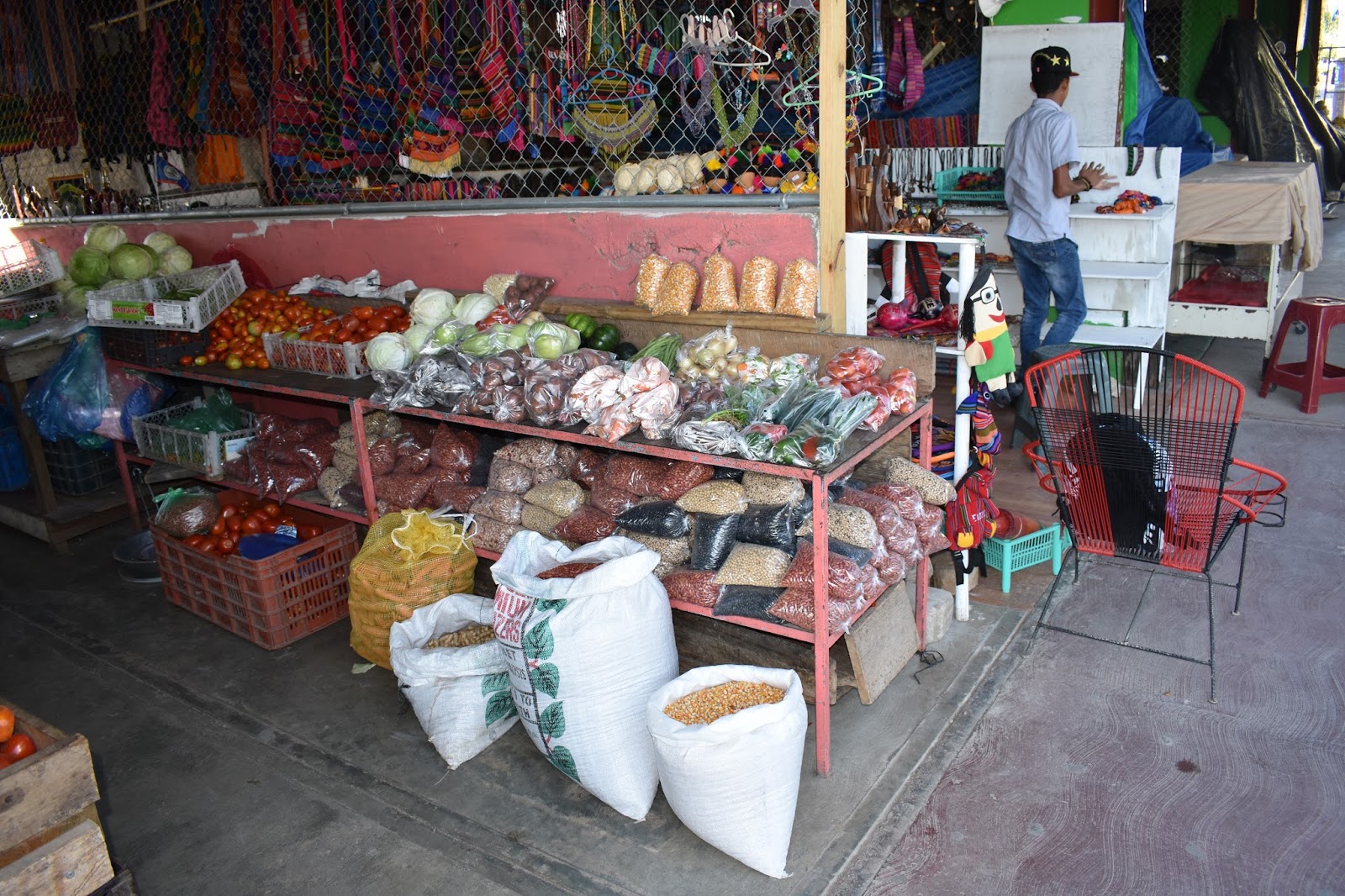
Today marks the midway point of our AEE 499: Indigenious Knowledge in Agriculture and Extension Education trip to Belize. We started off the day with a challenge task from our C.E.L.A. Belize guide Lauren to exploring the San Ignacio Market. The eight students split into three groups.

Group 3, made up of Britton, Erin, and myself, set out to create a nutritiously balanced meal from the ingredients in the market. We were given a $10 Belizean Dollar budget (the conversion rate to US dollars is 2 to 1). Our group originally planned to create a hypothetical meal and determine the prices for the ingredients. For example, I wanted to know the price difference for beans versus eggs in order to decide what our protein would be. Of course, these prices depend on the variety of beans and the eggs.

After trying to plan an American inspired meal without much success, I decided to ask one of the vendors what might be a local Mayan dish that would meet our nutritional needs. A conversation began between the vendor (Daniella), the students (Britton, Erin, and myself), and a lovely customer willing to share. She explained to us the recipe for Caldo which is a local soup that includes chicken, onions, cilantro, lime, jalapeƱos, and corn flour for homemade tortillas. With every ingredient listed, there was more and more knowledge that came with it.

In Belize, they have “Local” chicken and “Normal” chicken. Local chicken are raised traditionally, allowed to roam free. Whereas normal chicken are raised by Mennonites with more modern techniques like in the United States. The quality between these two are very distinct. The price for local chicken eggs in the market is $12 per tray, whereas normal eggs are $7 per tray (all Belizean currency). Our group began talking with a local customer and she explained to us that even though the local eggs are higher quality, she still buys the normal eggs because they are cheaper. However, on special occasions such as Christmas, she will pay the extra price to cook for the extended family.

Being able to have this type of interaction with the locals gave me access to information that I would never have thought to ask for. As an example of informal education, I was able to extract some indigenous knowledge from the brains of the locals that I might not have been able to learn in the classroom or on a farm tour. It was truly an enlightening experience.

Lex is a freshman majoring in BioRenewable Systems/Biological Engineering

Tuesday, March 6, 2018

Day 4: An UnBELIZEable Classroom Visit! (Olivia)


Picture livestock milling about in a lush green courtyard, children happily bantering in crisp, pressed uniforms, and passionate instructors with a passion for bettering their county and you’ll have pictured Mopan Technical High School, a trade school situated a few miles from the Guatemalan border.
Today my friends and I make the trek to MTHS to tour their facilities and interact with Belizean agriculture students. I was particularly excited for this opportunity because just like the Belizean students at Mopan Tech, I also attended trade school prior to coming to college.

During my time at MTHS, we learned about the hands-on opportunities that the school had to offer. For example, the agricultural students slaughtered their flock of chickens the day before we came to tour, they sell all of the produce that they grow, and even had a pond full of tilapia. This was strikingly similar to the goal of self-sufficiency that my own trade school had back home in the states.

Another similarity that I saw between Belizean vocational school and American vocational school was the passion that the instructors had for their students. Each classroom that we visited, regardless of the trade that was involved, was focused on innovation. And even though in the American context we tend to emphasize technological innovation over more traditional knowledge, innovation was nonetheless a crucial portion of their curriculum.

Finally, the highlight of my day had to have been my opportunity to speak with students. A particularly memorable conversation that I had was with one of our student tour guides. When I asked her why she chose agriculture, she told me that she enjoyed the challenge, loved to work the earth, and didn’t mind getting sweaty with the boys. She aspires to continue her education either in Honduras or the United States so that she can “make a big impact on her country someday.” It was in this moment that I truly saw a lot of myself in this young pupil, from her sheer grit to her passion for the industry. I have no doubt that she will accomplish many great, impactful things.

I have learned numerous important life lessons during my time in Belize, but so far my time at Mopan Technical High School has taken the cake. I couldn’t have asked for a better way to compare and contrast the Belizean and American education system than in a context that I have personally participated in myself. From the facilities, to the instructors, to the students themselves, I have no doubt that the future of Belizean agriculturalists are cultivated in the soil at Mopan Tech.

Olivia Richart is a sophomore majoring in Agricultural Sciences at Penn State.